
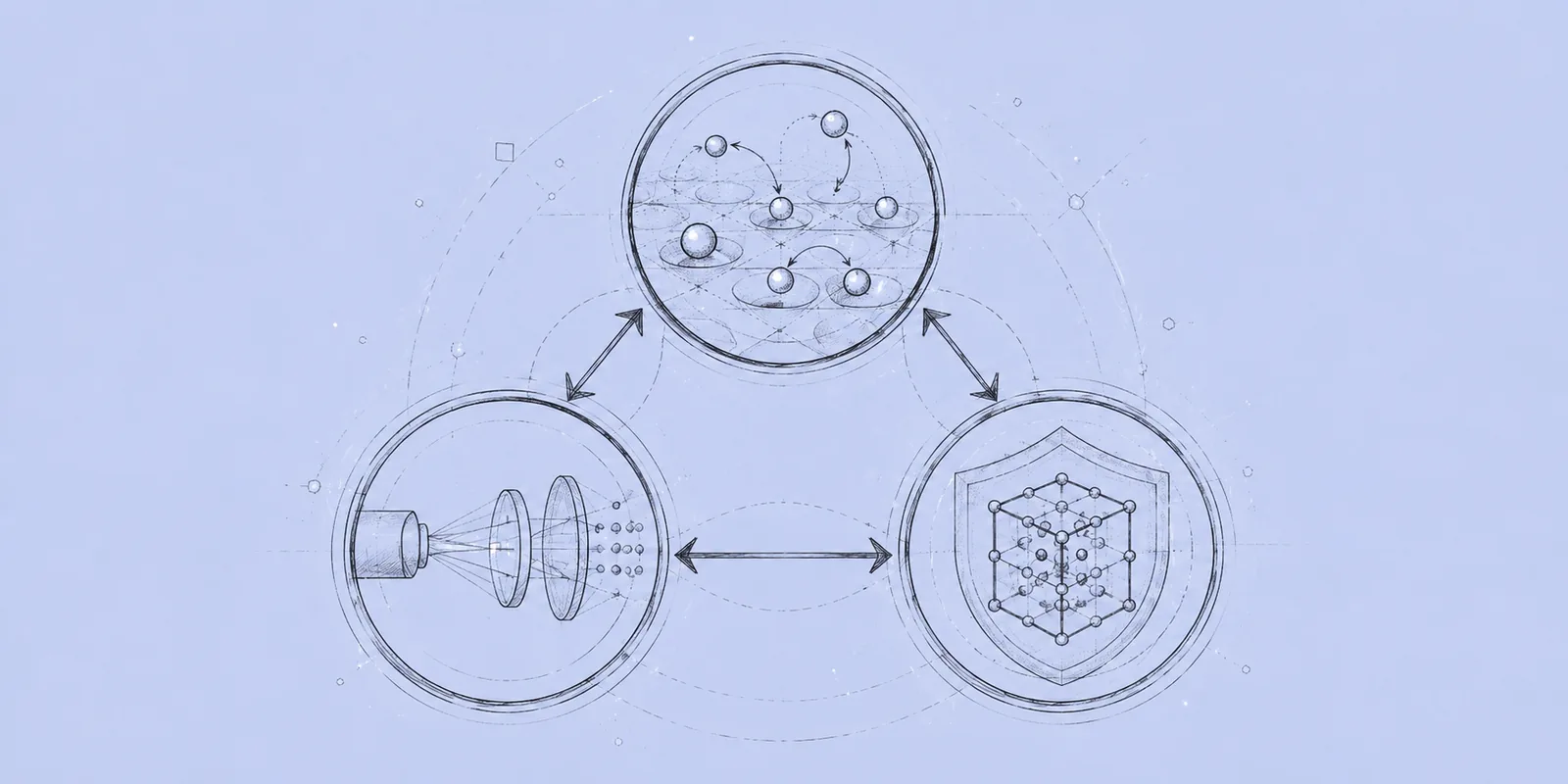
This is the second paper in our neutral-atom series. The first, Neutral-Atom Quantum Computing, maps the whole landscape: who is filing, which architectures are emerging and where the university lineages sit. If you have not read it, start there. This paper goes down one level, into the three bottlenecks that paper identified, and treats them as a single coupled system rather than three research topics.
Executive summary
Neutral-atom quantum computers are usually described through qubit counts, gate fidelities or Rydberg interaction strengths. The Vault tells a different story. The densest and most strategically revealing activity sits in the machinery required to keep a large atomic processor usable for long computations: loading and replacing atoms, controlling individual sites without an explosion in optics, and making atomic loss visible to the decoder. These are not secondary engineering details. They determine practical clock rate, error budget, capital intensity and ultimately the fault-tolerance overhead of the platform.
| Bottleneck | Vault signal | Strategic interpretation |
|---|---|---|
| Atom logistics | ~63 retrieved patent hits across loading, rearrangement, transport, repair and refill; broad assignee spread | The field is moving from “assemble a defect-free array” to “maintain a live array indefinitely.” Logistics is becoming part of the logical architecture. |
| Optical control | ~40 addressing-optics hits; two camps, scale channels versus reduce or avoid local addressing | The optical bill of materials and channel count may become a scaling limiter. Hybrid control architectures are converging fastest. |
| Erasure-aware QEC | One especially clear erasure-conversion anchor family plus a much denser adjacent patent and literature cluster | Neutral atoms can turn a platform weakness, atom loss, into located error information. That can lower decoding and QEC overhead if implemented end to end. |
The report therefore treats the three as an integrated stack. The most important competitive question is not “who has solved each problem?” but “which architecture minimises the combined time, error, hardware and software cost of solving all three, repeatedly?”
1Scope, method and evidence discipline
The evidence base is deliberately asymmetric. Roughly 80% of the substantive observations, patent examples, portfolio signals, publication leads and white-space hypotheses originate in the Strata IP Quantum Vault. The remainder is external corroboration: peer-reviewed articles, recent preprints, patent gazette records and official company research updates, used to verify key numbers, update developments after the Vault cut, or correct attribution.
1.1 Evidence hierarchy
- Vault patent and publication findings are the analytical spine. Counts are treated as signals, not as a legally complete patent census.
- Vault-indexed publications are linked to the underlying journal or preprint so the reader can inspect the primary source directly.
- External-only sources are used sparingly, for corroboration, current-state updates or corrections, never to replace the Vault analysis.
- Patent to paper relationships are described as mechanistic or topical unless a formal citation, common inventorship, assignment, licensing relationship or judged relationship analysis is established.
- Apparent white space means “not seen in this Vault slice.” It is not a patentability, novelty, validity, infringement or freedom-to-operate conclusion.
1.2 Data-quality cautions that materially affect interpretation
Assignee aliases matter. ColdQuanta and Infleqtion must be consolidated. QuEra is materially undercounted by first-assignee-only filtering, because university co-assignment is common.
Publication year is not filing year. A sharp publication spike may reflect older priority dates and examination timing rather than a sudden research or financing event.
Harvard’s headline count is an upper bound for the neutral-atom cluster, because some records relate to adjacent quantum technologies.
2Bottleneck one: atom logistics
The problem has shifted from “can we load atoms?” to “can we keep computation running?”
The Vault’s strongest hardware theme is atom logistics: source preparation, stochastic loading, defect removal, rearrangement, transport between functional zones, replacement of lost atoms and continuous refill. A logistics-focused search returned 63 patent hits spanning direct competitors, universities, telecom companies and national-lab ecosystems. The breadth of assignees is itself evidence that the problem is architectural rather than company-specific.
2.1 Five sequential handoffs
| Stage | Representative Vault records | What is being solved |
|---|---|---|
| 1. Source / preparation | US-12148543-B2, US-20250385021-A1, US-20250324507-A1 | Atomic flux, vacuum-compatible sources and stable delivery. Relatively under-patented versus ion systems. |
| 2. Loading | EP-4649506-A1 / CA-3278876-A1 (Pasqal/CNRS); EP-4273889-B1 (AtomQL) | Avoid or compensate stochastic occupancy. Pasqal attacks over-occupancy at the source with a repulsive barrier; AtomQL proposes self-ordering ions followed by neutralisation. |
| 3. Rearrangement | CN-120338130-A (Shanxi); US-12462946-B2 (QuEra); WO-2026091637-A1 (Huawei) | Fill vacancies and move many atoms with fewer sequential operations. Scheduling becomes as important as tweezer physics. |
| 4. Transport | US-20250378972-A1 (Atom Computing); US-20260045383-A1 (ETH Zurich) | Move atoms between incompatible operating zones or lattice spacings without losing coherence or trap depth. |
| 5. Repair / refill | US-20240249173-A1 (Atom Computing); US-20240371967-A1 (ColdQuanta); WO-2025255376-A1 (Harvard) | Replace lost qubits and continuously replenish a local reservoir while computation continues. |
2.2 Loading: the 50% occupancy problem is being attacked at multiple layers
The conventional optical-tweezer workflow accepts probabilistic loading and then rearranges
atoms into a defect-free target. The Vault shows an emerging alternative: reduce the amount of
rearrangement needed in the first place. Pasqal and CNRS’s EP-4649506-A1 detects
trap occupancy and introduces a repulsive optical barrier once the desired occupancy is reached.
That is a qualitatively different bet from post-loading rearrangement: improve the loading physics
rather than make the scheduler ever more sophisticated.
The Vault also surfaces a structurally unusual idea in EP-4273889-B1 (AtomQL):
use Coulomb repulsion to self-organise ions into an ordered array, then neutralise them after
placement. It is isolated in the supplied landscape, but strategically interesting because it
bypasses the stochastic optical loading loop instead of optimising it.
2.3 Rearrangement: patent density is thinner than publication density
Rearrangement is where the patent and publication asymmetry becomes visible. The Vault’s
patent examples span image-feedback dynamic tweezers (CN-120338130-A), binary-coded
parallel movement decisions (US-12462946-B2) and internal-state-dependent collective
movement (WO-2026091637-A1). The publication corpus is much richer: Tetris-like
packing, reduced-path planning, highly parallel composite moves, loss-aware replanning and
square-root-time reconfiguration all appear in recent literature. Neutral-atom compilation is
becoming partly a robotics and scheduling problem, in which movement cost and failure probability
must be optimised alongside the quantum circuit.
2.4 Transport: separating dirty and clean zones becomes an architectural primitive
Atom Computing’s US-20250378972-A1 is revealing because its problem statement
is architectural: loading and laser cooling are hostile to stored coherence, so the loading region
and the computation region must be separated. The invention is not merely “move an
atom”; it is “make zoned operation possible without sacrificing trap depth or coherence
during the move.” ETH Zurich’s US-20260045383-A1 addresses a related
handoff between different spatial periods.
2.5 What to measure when comparing companies
| Metric | Why it matters |
|---|---|
| Initialised atoms per second | Measures replenishment throughput rather than headline array size. |
| Replacement latency per lost qubit | Contributes directly to QEC cycle time and idle error. |
| Transport fidelity × distance | Captures whether zoned architectures remain viable as machines grow. |
| Reservoir refill while preserving coherence | Distinguishes true continuous operation from periodic maintenance. |
| Rearrangement depth and parallelism | Determines how quickly defect maps can be repaired. |
| Loss-aware scheduling overhead | Shows whether control software keeps pace with physical logistics. |
3Bottleneck two: individual optical control
The field is choosing between scaling the channels and deleting the requirement.
The second dense Vault theme concerns how to control one atom, or one selected subset, inside a dense array without disturbing its neighbours. The search returned roughly 40 addressing-optics hits. Pasqal and Atom Computing dominate the corporate side after alias consolidation, while the academic layer includes MIT, Wisconsin and Tsinghua. The trade-off is stark: local control buys generality and circuit depth, but the required optics can grow with qubit count; global control suppresses hardware scaling but constrains the gate set and shifts complexity into compilation, atomic species, frequency selectivity or interaction geometry.
3.1 Path A: scale the optics
| Sub-bottleneck | Vault examples | Technical strategy |
|---|---|---|
| AOD bandwidth and uniformity | US-11513418-B2 (Tsinghua); US-12198010-B2; US-20240337893-A1 (IonQ) | Cascade or re-engineer acousto-optic stages so beam quality, momentum transfer and acoustic reflections do not become the scaling wall. |
| SLM refresh rate | US-11575860-B2 (WARF); US-11120360-B2 (MIT) | Use structured illumination or stored holographic circuit layers to gain parallelism despite slower spatial modulators. |
| Hybrid fast + spatial control | WO-2024112864-A1 (WARF) | Use a fast deflector to hop among SLM regions, performing multiple gates per SLM frame. |
| Split the control task | CA-3274556-A1; EP-4625267-A1 (Pasqal) | Assign temporal and spatial modulation to different Hamiltonian components; encode phase rather than relying only on intensity. |
| Fibre and integrated delivery | US-20250356236-A1 (UChicago); US-20250356237-A1 (Princeton) | Give many sites dedicated optical channels to avoid slow shuttling and reduce shared-beam compromises. |
The most important signal is not a single patent but repeated filings around the same optical limitations. Pasqal appears across addressing architecture, phase and intensity control, MEMS and interferometric concepts, integrated optics and alternative laser sources. Multiple filings against one engineering cost centre generally mean the problem is on the critical path.
3.2 Path B: avoid local addressing
| Vault record | Mechanism | What is traded away |
|---|---|---|
US-12548688-B2 (Harvard) | Global pulses plus Rydberg blockade geometry implement parallel multi-qubit operations. | Less per-site optics; more dependence on grouping, geometry and interaction design. |
US-12614098-B2 (Max Planck) | One addressing laser at two frequencies performs different functions. | Reduced hardware duplication; tighter spectral and control constraints. |
CN-115409191-A (Huayi Boao) | Move non-target qubits into a different internal state, then use a global beam. | Selection moves from spatial beam steering to state preparation. |
US-20250209356-A1 (Pasqal) | Digital-analog evolution, so global Hamiltonian dynamics replace many addressed gates. | Less gate-by-gate addressing; more compiler dependence on native analog dynamics. |
The strategic point is that Pasqal patents both sides. It invests in better addressing hardware and in circuits that require less addressing. That is architectural hedging rather than contradiction: a company does not need to predict which extreme wins if it can own useful hybrid territory between them.
3.3 The publication frontier is moving into modulator physics
Device research is moving faster than many platform patents. Christen et al. demonstrated a 16-channel thin-film lithium-niobate photonic engine with visible-wavelength operation, CMOS-compatible drive voltages and multi-GHz modulation, reaching a PCB-limited 7 GHz switching bandwidth at 780 nm (Christen et al., 2025). Vanackere et al. then demonstrated a silicon-nitride, piezoelectrically actuated spatial light modulator fabricated on 200 mm wafers, with above 100 MHz modulation and above 20 dB extinction (Vanackere et al., 2025). A 2026 Stanford preprint encodes spatial information into optical frequency bins and decodes it with a two-dimensional spectrometer, reporting a 44 ns rise time, more than 10 million frames per second, while retaining reconfigurable two-dimensional beam control (Wei et al., 2026).
These results do not prove that any given processor will adopt one modulator platform. They validate the deeper point: optical control is becoming a semiconductor and photonics integration problem, not merely a laser-alignment problem.
3.4 The delete-addressing camp is accelerating
The Vault flagged a thinner patent landscape around global-control alternatives, while recent publications are far more explicit. Kazemi et al. use globally phase-modulated Rydberg driving for multiqubit parity operations; Doultsinos and Petrosyan propose a stationary Rydberg excitation bus for gates between distant atoms; a 2026 quantum-actuators proposal uses auxiliary systems to activate selected interactions under global drive; and Wang et al. propose a toric-code memory using three atomic species and global species-selective pulses, explicitly avoiding atom movement, local addressing and mid-circuit fluorescence measurement (Kazemi et al., 2025; Doultsinos and Petrosyan, 2025; Menta et al., 2026; Wang et al., 2026).
These are research proposals, not production systems. Their importance is directional: the cost of local optics is high enough that credible groups are redesigning the architecture to remove it. That creates counter-pressure against movement-heavy, individually addressed machines.
3.5 The likely outcome is hybrid
The most recent Vault patents already cluster in the middle: deflector plus SLM, temporal plus spatial modulation, one laser with multiple functions, digital plus analog computation. Pure global control struggles with arbitrary programmability; pure local control struggles with channel count, calibration and cost. A scalable machine will likely use global operations wherever symmetry permits, local operations only where information flow requires them, and integrated photonics to compress the remaining optical bill of materials.
4Bottleneck three: erasure-aware error correction
Turning a platform weakness into decoder-friendly information.
4.1 The anchor patent is unusually direct
The Vault identified US-12657505-B2, “Efficient quantum error correction in
neutral atoms by conversion to erasure errors,” as the clearest claim set directed at erasure
conversion itself. The claims broadly cover an array of encoded neutral atoms or ions, optical
detection of departure from the computational space, and use of the known location in error
correction. The claim analysis also highlights negative limitations around detecting that departure
without disturbing qubits that remain in the computational space, plus species-specific dependent
claims around ytterbium transitions.
External cross-checking adds an attribution detail: the June 2026 US grant is assigned jointly to The Trustees of Princeton University and the Wisconsin Alumni Research Foundation, not Princeton alone. That matters when mapping licensing or collaboration pathways, though it does not change the technical reading of the claims (USPTO Patent Gazette, 2026).
4.2 The adjacent landscape splits into three philosophies
| Philosophy | Representative Vault patents | What the architecture does |
|---|---|---|
| A. Engineer the error channel | US-12657505-B2 (Princeton/WARF); US-20240185113-A1 (Harvard/QuEra) | Use metastable states, selection rules, ancillas or optical pumping so damaging leakage becomes detectable, biased or recoverable. |
| B. Suppress or repair physical loss | US-20260080295-A1 (Atom Computing); US-20260066148-A1 (ColdQuanta); WO-2026120174-A1 (Pasqal) | Accept that loss occurs, then replace the qubit, drain Rydberg population, or de-excite quickly enough to prevent a lost atom. |
| C. Make the decoder loss-aware | US-20250328806-A1 and family (Riverlane) | Treat leakage and loss events as runtime information that changes decoder weights and hypergraph interpretation. |
This is more useful than asking who owns erasure correction. The Vault shows a stack: physical-state engineering at the qubit layer, maintenance and replacement at the hardware layer, and leakage-aware decoding at the classical layer. A production system can combine all three, so the competitive moat may lie in cross-layer orchestration rather than in any isolated erasure mechanism.
4.3 Why erasure bias is valuable
The scientific sequence is unusually coherent. Wu et al. proposed that alkaline-earth Rydberg qubits could convert a large fraction of dominant gate errors into detectable erasures. Ma et al. then demonstrated high-fidelity gates and mid-circuit erasure conversion in metastable 171Yb qubits. Scholl et al. independently demonstrated erasure conversion and detection in a high-fidelity Rydberg simulator. Sahay et al. showed that codes tailored to biased erasure noise tolerate much higher error rates than generic noise models (Wu et al., 2022; Ma et al., 2023; Scholl et al., 2023; Sahay et al., 2023).
The significance is not simply better error correction. It is error-model engineering. Rather than forcing the decoder to assume a generic Pauli channel, the hardware transforms dominant physical failures into a structured channel the code can exploit. That changes the resource equation: fewer ambiguous errors can mean lower code distance, fewer ancillas, fewer syndrome rounds, or more forgiving thresholds for the same target logical error rate.
4.4 From component demonstrations to logical circuits
The Atom Computing and Microsoft processor work used 256 ytterbium atoms and designed operations so that important error sources become detectable atom loss. The team demonstrated entanglement of 24 logical qubits encoded into 48 atoms, and reported improved performance when erasure information was used (Reichardt et al., 2024). In June 2026, Zhang et al. reported logical qubits and logical circuits using metastable 171Yb with noise biased toward erasures, including mid-circuit erasure measurements and conditional recovery (Zhang et al., 2026).
The 2026 Atom Computing toric-code result adds the systems dimension: lost atoms are not only detected but replaced during repeated syndrome extraction, and the reservoir itself is reloaded. This is the clearest evidence that the three bottlenecks have merged. Erasure-aware QEC is only useful at depth if logistics can replace erased qubits and optical control can measure and reset the necessary subset without decohering the rest (Atom Computing et al., 2026).
4.5 The next branch creates erasures on purpose
The Vault flagged loss-biased fault-tolerant error correction as an emerging unpatented direction. Pecorari et al. propose fast mid-circuit ionisation to convert spurious Rydberg excitation into atom loss, deliberately turning correlated excitation errors into erasure-like noise and enabling shorter QEC cycles (Pecorari et al., 2026). Once located loss is easier to correct than hidden coherent error, losing an atom can become preferable to keeping a corrupted one.
4.6 A counter-direction removes the erasure check
Another branch avoids mid-circuit leakage detection and local corrective action altogether. Measurement-based or globally controlled architectures push error handling into cluster-state geometry, species-selective global control, or coherent correction. The 2026 measurement-free toric-code proposal is the extreme case: no atom movement, no local addressing, no mid-circuit fluorescence measurement. Whether such architectures win experimentally is uncertain, but their existence signals that conventional QEC-cycle overhead is now large enough to motivate architectural redesign (Wang et al., 2026).
4.7 What to measure when comparing companies
| Metric | Why it matters |
|---|---|
| Fraction of dominant errors converted to detectable erasures | Direct measure of how much hidden error is reshaped into located error. |
| False-positive and false-negative erasure detection | Bad flags can erase the theoretical threshold advantage. |
| Erasure-check latency and disturbance | Detection must not decohere surviving data qubits. |
| Replacement and reinitialisation time | Determines whether erasures can be repaired inside a practical QEC cycle. |
| Decoder use of erasure metadata | Shows whether the classical stack actually exploits the physical information. |
| Logical error versus code distance under real loss | The ultimate proof that erasure bias survives the full system stack. |
5The three are converging into one architecture problem
Why optimising each layer separately can produce the wrong machine.
The strongest conclusion from the Vault is cross-layer. A company can improve each bottleneck independently and still lose at the system level. Faster atom movement can increase heating or control complexity. More local addressing reduces movement but increases channel count and calibration. Erasure checks improve decoding but increase measurement latency, reset traffic and replacement demand. Fault tolerance multiplies these interactions, because the same operations repeat thousands or millions of times.
| Architecture tendency | Logistics choice | Control choice | QEC choice | Strategic character |
|---|---|---|---|---|
| Harvard / QuEra | Move logical blocks, maintain zoned arrays | Mix global gates with reconfigurable geometry | Loss detection plus transversal logical operations | Treat mobility as a computational primitive. |
| Atom Computing | Reservoir, zone maintenance, mid-circuit replacement | Zoned control with dynamically moved Yb atoms | Erasure-aware logical computing; repeated QEC with replacement | Treat continuous maintenance as part of execution. |
| Pasqal | Improve loading and array operations pragmatically | Patent both scalable addressing and lower-addressing digital-analog methods | More visible in loss avoidance than in erasure conversion | Monetise analog now while hedging the control stack. |
| Infleqtion / ColdQuanta | Array repair and cold-atom infrastructure | Broad cold-atom control heritage | Drain-pulse approach detects Rydberg excitation without losing the atom | Favour recovery and loss avoidance. |
| Global-control research | Minimise or eliminate movement | Species-selective and global pulses, buses, actuators | Coherent or measurement-free correction | Trade programmability for flatter local-control overhead. |
5.1 Clock rate is becoming more important than qubit count
A credible 10,000-atom machine is not necessarily a better computer than a 3,000-atom machine if every QEC round is slowed by transport, imaging, reset, refill and optical calibration. The next useful industry metric will look more like “logical operations sustained per second under continuous maintenance” than “physical atoms trapped.” That metric forces logistics, control and QEC into one denominator.
5.2 The most valuable IP may sit at the interfaces
- Scheduler to rearrangement hardware: choose moves using real-time defect maps and loss probability.
- Optical controller to compiler: exploit global operations where possible, reserve local beams for information-theoretically necessary steps.
- Measurement to reservoir manager: turn detected erasures into replacement tasks automatically.
- Decoder to physical control: use erasure confidence to alter recovery, not merely report an error.
- Reservoir to QEC cadence: refill before inventory depletion becomes a logical failure mode.
5.3 Competitive context: a large incumbent enters
In March 2026 Google Quantum AI announced that it is adding neutral-atom research alongside superconducting qubits, describing neutral atoms as complementary and emphasising very large arrays while superconducting systems retain far faster cycle times (Google Quantum AI, 2026). That does not alter the three bottlenecks. It raises their strategic importance, because the framing mirrors the Vault thesis exactly: neutral atoms have a scale and connectivity opportunity, but they must close the cycle-time, control and fault-tolerance gap to use it.
6Emerging white spaces and watch items
Research hypotheses from the Vault, not legal conclusions.
| Area | Why it looks under-represented | What would make it important |
|---|---|---|
| Loss-aware atom scheduling | Many publications on parallel, loss-aware rearrangement; relatively few clearly targeted patents in this slice. | As arrays become continuously maintained, scheduling becomes part of the QEC clock and directly affects throughput. |
| Fast deterministic loading | Pasqal has a notable position, but 2026 Rydberg-blockade loading publications show alternative physics. | Could reduce the need for large rearrangement overhead and reservoir inventory. |
| Visible and UV integrated modulators | Recent photonics papers move beyond commercial AOD and LCoS assumptions. | A scalable modulator platform can serve multiple architectures beneath the QPU brand layer. |
| Stationary relay and bus architectures | Specific global-control and Rydberg-bus mechanisms are published; little direct claiming found. | Could provide nonlocal connectivity without moving data atoms or scaling local optics. |
| Loss-biased QEC via deliberate ionisation | Published 2026 concept converts correlated Rydberg excitation into located loss. | If practical, it could reshape the optimal physical error channel and shorten QEC cycles. |
| Cross-layer erasure orchestration | Patents exist separately on detection, replacement and decoding. | An integrated scheduler, decoder and control loop could become a defensible systems moat. |
7Questions to ask neutral-atom companies
Use the bottlenecks to move conversations beyond qubit counts.
- How many initialised replacement atoms per second can the system supply during an active computation, and what happens to coherence elsewhere while the reservoir refills?
- What is the end-to-end latency from detecting a lost atom to having a replacement reinitialised and available to the next QEC round?
- How many physical atom moves are required per logical two-qubit operation in the target architecture?
- At full target array size, what part of the optical stack scales approximately linearly with qubit count?
- What is the worst-case addressing crosstalk and calibration overhead when many sites are driven in parallel?
- What percentage of the intended fault-tolerant circuit can run on global or broadcast operations rather than site-selective control?
- What fraction of dominant physical errors is converted into located erasures, and how is that measured experimentally?
- How often does erasure detection itself disturb a good qubit or produce a false flag?
- Does the classical decoder consume erasure confidence in real time, or is it used only for post-selection?
- What is the complete QEC cycle time including transport, measurement, decode, feed-forward, reset, cooling and replacement, not only gate time?
- Which key patents are owned directly, which are university co-assigned, and which are licensed? How are legacy names such as ColdQuanta and Infleqtion normalised?
- Which system-level metric do you expect to improve fastest over the next 24 months: atom availability, control parallelism, erasure bias, or logical error per second, and why?
8Outlook: what to watch through 2028
From impressive arrays toward continuously maintained logical machines.
Neutral atoms will continue to post larger physical arrays, but raw size will become less differentiating. The frontier moves toward sustained logical operation under continuous maintenance. The groups that matter will increasingly disclose cycle-level metrics: how much movement occurs, how often atoms are lost, how quickly they are replaced, how many control channels operate in parallel, how much error becomes erasure information, and whether logical error decreases when all of those operations repeat.
- Atom logistics will be judged by sustained throughput, not pre-run fill fraction.
- Optical control will migrate toward hybrid global and local architectures with more integrated photonics.
- Erasure conversion will be judged at the logical level, not by isolated state-detection demonstrations.
- Software will move closer to hardware: scheduling, loss maps, calibration and decoding sharing real-time state.
- University and spinout IP structures will remain strategically important, making co-assignee and inventor normalisation essential.
The central thesis is therefore broader than “neutral atoms can scale to many qubits.” The more defensible version: neutral atoms can become a fault-tolerant platform if their physical flexibility is converted into lower system overhead rather than higher system complexity. The three bottlenecks in this report are where that conversion will be won or lost.
Appendix: Vault findings carried forward
188 filings across six consolidated entities, by publication year. Two rows carry known distortions and are drawn dashed: Harvard’s 52 is its whole quantum portfolio, including diamond-NV and nanophotonics work, so it is an upper bound on neutral atoms. QuEra at 3 is not credible for one of the leading companies in the field, and is discussed below.
What the grid says
- Pasqal is a different kind of filer, not merely the largest. 81 patents, 53 of them published in 2025 alone, across three legal entities including a Dutch one. That is not organic research output; it is a deliberate portfolio push, and the Netherlands B.V. appearing in 2024 and 2025 suggests a European filing structure built for it. Nobody else shows a fivefold year-on-year spike.
- The 2026 column belongs to Harvard. 15 in 2026 against 8 in 2025, its largest year in a twenty-year record, while Atom Computing held flat at 12 and Pasqal fell from 53 to 18. 2026 is a partial year and publication lags filing by around 18 months, so those counts will grow. The direction is what matters: the academic anchor is accelerating while the commercial leader digests its 2025 wave.
- ColdQuanta and Infleqtion peaked in 2024 and have declined since (11, then 5, then 3). It is the only falling trend in the grid, and the only entity whose record starts before 2021. Read alongside the rebrand, that is either a company that filed heavily on its cold-atom base and moved output elsewhere, or one filing under a name this Vault is not catching.
- The field is startlingly young. Outside Harvard there is essentially nothing before 2021 and little before 2024. Every commercial portfolio here is under three years old in publication terms, which means few granted rights, thin prosecution history, and priority dates from 2022 and 2023 deciding the next decade.
- planqc appears only in 2026, with two filings. A European entrant arriving as Pasqal’s wave crests is a watch item, not a conclusion.
Tag-based scoping was tested as an alternative population definition (“neutral atom”, “Rydberg”, “optical tweezers”, “cold atoms” and variants). It returns only 54 patents vault-wide and misses Atom Computing entirely, so the tag layer is too sparse to build this grid on. The company axis is the sounder basis.
- Erasure conversion: one particularly direct anchor grant
(
US-12657505-B2) plus a broader set of adjacent inventions covering detection, loss repair, de-excitation and leakage-aware decoding. - Optical addressing: approximately 40 hits, Pasqal and Atom Computing highly visible after consolidating name variants, in two architectural camps.
- Atom logistics: approximately 63 hits across loading, rearrangement, transport, repair and refill, distributed across companies, universities and other institutions.
- Relationship caveat: several patent-paper pairings were topical or mechanistic matches rather than judged relationship determinations.
References and source provenance
Harvard-style author–date referencing; hyperlinks point to the primary public source. Approximately 80% of the analysis originates in the Strata IP Quantum Vault, with external sources used to verify publication details, validate performance numbers, correct attribution, and update competitive context.
Vault-indexed publications
- Atom Computing et al. (2026) Quantum error correction with the toric code. Available at: arXiv:2606.04079
- Chiu, N.-C. et al. (2025) ‘Continuous operation of a coherent 3,000-qubit system’, Nature, 646, pp. 1075–1080. doi: 10.1038/s41586-025-09596-6
- Christen, I. et al. (2025) ‘An integrated photonic engine for programmable atomic control’, Nature Communications, 16, 82. doi: 10.1038/s41467-024-55423-3
- Doultsinos, G. and Petrosyan, D. (2025) ‘Quantum gates between distant atoms mediated by a Rydberg excitation antiferromagnet’, Physical Review Research, 7, 023246. Available at: journals.aps.org
- Kazemi, J. et al. (2025) ‘Multiqubit parity gates for Rydberg atoms in various configurations’, Physical Review Research, 7. Available at: journals.aps.org
- Ma, S. et al. (2023) ‘High-fidelity gates and mid-circuit erasure conversion in an atomic qubit’, Nature, 622, pp. 279–284. doi: 10.1038/s41586-023-06438-1
- Manetsch, H. J. et al. (2025) ‘A tweezer array with 6,100 highly coherent atomic qubits’, Nature. doi: 10.1038/s41586-025-09641-4
- Menta, R. et al. (2026) ‘Global control via quantum actuators’, arXiv. Available at: arXiv:2603.23362
- Norcia, M. A. et al. (2024) ‘Iterative assembly of 171Yb atom arrays with cavity-enhanced optical lattices’, PRX Quantum, 5, 030316. Available at: journals.aps.org
- Pecorari, L. et al. (2026) ‘Loss-biased fault-tolerant quantum error correction’, arXiv. Available at: arXiv:2604.21876
- Reichardt, B. W. et al. (2024) ‘Fault-tolerant quantum computation with a neutral atom processor’, arXiv. Available at: arXiv:2411.11822
- Sahay, K. et al. (2023) ‘High-threshold codes for neutral-atom qubits with biased erasure errors’, Physical Review X, 13, 041013. Available at: journals.aps.org
- Scholl, P. et al. (2023) ‘Erasure conversion in a high-fidelity Rydberg quantum simulator’, Nature, 622, pp. 273–278. doi: 10.1038/s41586-023-06516-4
- Vanackere, T. et al. (2025) ‘Piezoelectrically actuated silicon-nitride-based high-speed spatial light modulator’, Nature Communications, 16, 11637. doi: 10.1038/s41467-025-66718-4
- Wang, H. et al. (2026) ‘Measurement-free toric-code memory in a globally controlled Rydberg array’, arXiv. Available at: arXiv:2606.12030
- Wei, X. et al. (2026) ‘A 10 megahertz spatial light modulator’, arXiv. Available at: arXiv:2601.08906
- Wu, Y. et al. (2022) ‘Erasure conversion for fault-tolerant quantum computing in alkaline-earth Rydberg atom arrays’, Nature Communications, 13, 4657. doi: 10.1038/s41467-022-32094-6
- Zhang, B. et al. (2026) ‘Logical qubits with erasure conversion using metastable neutral atoms’, Nature Physics, 22, pp. 910–916. doi: 10.1038/s41567-026-03309-0
External corroboration and corrections
- Google Quantum AI (2026) Building superconducting and neutral atom quantum computers, 24 March. Available at: blog.google
- USPTO Patent Gazette (2026) US 12,657,505 B2, Efficient quantum error correction in neutral atoms by conversion to erasure errors, 16 June. Used to verify grant and joint assignment. Available at: patentsgazette.uspto.gov
Selected Vault patent records
US-12657505-B2Efficient quantum error correction in neutral atoms by conversion to erasure errors Princeton / WARFUS-20260080295-A1Methods and systems for error correction in neutral atom quantum computers Atom ComputingUS-20260066148-A1Techniques for detection of Rydberg excitations ColdQuantaWO-2026120174-A1Reducing particle loss in a Rydberg-based quantum processing unit PasqalUS-20240185113-A1Fault-tolerant quantum computation Harvard / QuEraUS-20250328806-A1Leakage-aware decoding family RiverlaneUS-20240249173-A1Continuous operation of a cold-atom device using a separate reservoir array Atom ComputingWO-2025255376-A1Continuous reloading of atomic qubits including two optical conveyor belts HarvardUS-12462946-B2Methods and apparatus for arranging atoms in arrays QuEraUS-20250356236-A1Individual qubit control for atom-array processors University of ChicagoUS-12548688-B2Parallel implementation of multi-qubit quantum gates HarvardCA-3274556-A1Qubit addressing PasqalWO-2024112864-A1Multi-scale architecture for optical addressing and control of qubit arrays WARF
Strata IP Quantum Vault (2026) Neutral-atom quantum computing patent and publication extracts. Internal research dataset, accessed 16 August 2026. Primary source for the patent counts, assignee clusters, publication leads and white-space hypotheses in this paper. This is technology and competitive-intelligence analysis, not a freedom-to-operate, validity, infringement or legal opinion.
How this was produced
Vault-led: roughly 80% of the observations, patent examples, portfolio signals and white-space hypotheses come from the Strata IP Quantum Vault. External sources are used in four roles only: verifying Vault-indexed publication details, validating performance numbers, correcting attribution such as the joint assignment on US-12657505-B2, and updating competitive context. Counts are signals, not a legally complete census; white space means a sparse signal in this Vault slice, not an assertion that no relevant patent exists.
Contributors: Strata IP Research